
How to Actually Get Your Song on Spotify and Apple Music
There's a moment almost every artist hits. The mix is done. The master came back and it sounds right. You open Spotify, ready to put the thing into the world — and you go looking for the upload button.
It isn't there. It never was.
This is the single most common point of confusion in independent music, and it catches almost everyone once. SoundCloud lets you upload. YouTube lets you upload. Bandcamp lets you upload. So the assumption is reasonable: Spotify and Apple Music must work the same way.
They don't. And once you understand why, the rest of the process stops feeling like a locked door and starts looking like a system you can work.
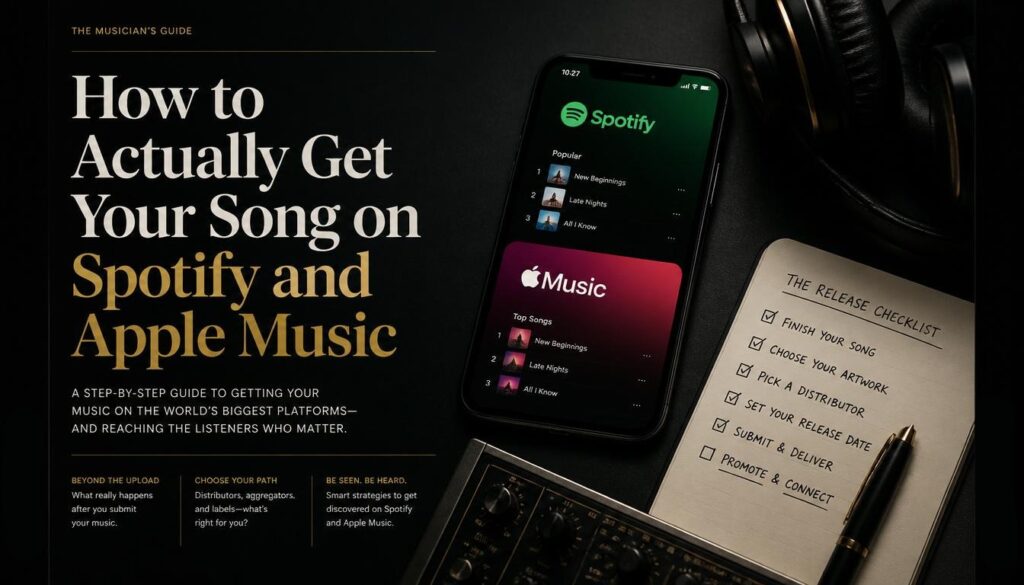
Why the major platforms don't take direct uploads
Spotify, Apple Music, Deezer, Tidal, Amazon Music and YouTube Music don't accept music directly from unsigned artists. They receive music from labels and approved distributors — companies that have been vetted and granted delivery access.
This isn't gatekeeping for its own sake. It's an infrastructure problem.
Every track that lands on a streaming platform arrives as a package: the audio file, the artwork, and a dense layer of metadata telling the platform who made this, who wrote it, who owns it, where it's allowed to be sold, and who gets paid when someone presses play.
That data travels in a standardised industry format, and it has to be correct on arrival. There's an ISRC code identifying the recording, a UPC identifying the release, songwriter splits feeding the publishing side, and an artist identifier that decides whether your streams attach to your profile — or get dumped onto a stranger's page who happens to share your name.
Multiply that by hundreds of thousands of tracks a week, and you can see why the platforms don't want a raw upload form.
They want clean, structured, verified deliveries from partners who know what they're doing. That partner is your distributor — and choosing the right one decides far more than whether your song simply goes live.

What you need before you distribute anything
Before you go near a distribution platform, get these in order. Doing it properly is the difference between a clean release and three months of cleanup.
-
Your master
A finished, mastered WAV — 16-bit / 44.1kHz minimum. Don't send an MP3 bounce. Don't send a rough mix you plan to fix later. Once a release is live, changing the audio means a takedown and a re-release, and you lose your stream count, your playlist placements and your release date.
-
Your artwork
Square, minimum 3000×3000 pixels, RGB, no blurry text, no platform logos you don't own, no imagery you don't have rights to. Artwork rejection is one of the most common reasons a release gets held up.
-
Your metadata
Artist name spelled exactly the way you want it to appear forever. Consistent capitalisation on track titles. Featured artists in the correct field — not jammed into the title. Genre, language, and explicit flags where they apply.
-
Your rights
Do you own or control everything in the recording? Samples cleared? A signed split agreement with your producer and co-writers? Distributors will ask you to confirm this. If you're wrong, the release comes down and the money gets frozen. Handle it before, not after.
-
Your credits and splits
Who wrote it, who produced it, who performed on it, and what percentage each person receives. Get this in writing while everyone is still happy with each other.
-
Your lead time
This is the one that hurts people most. Spotify needs several business days just to process a delivery, and the realistic timeline from submission to live is closer to two weeks.
The four-week rule. If you want any real shot at editorial playlist consideration, your release needs to be delivered and pitched at least four weeks ahead of release date. Artists who submit on a Wednesday for a Friday release aren't releasing on Friday — and they've already forfeited every pitching window that mattered.
What a distributor actually does
The word "distributor" undersells it. Delivery is the easy part.
A distributor sits between you and every platform on earth. It encodes and formats your release, delivers it to each DSP, registers your identifiers, monitors for delivery errors, collects royalties from dozens of sources in dozens of currencies, and pays that money through to you.
Then there's everything around the release:
Playlist pitching
Getting your track in front of editorial teams and into algorithmic rotation — with enough lead time for it to count.
Profile claiming
Verifying your Spotify for Artists and Apple Music for Artists profiles so your streams and data land where they belong.
Royalty collection
Chasing revenue you're owed from sources you didn't know were paying — including publishing and neighbouring rights.
Off-platform revenue
Income streams that live entirely outside Spotify and Apple. This is where most African artists are leaving real money behind.
That last one deserves its own section — because it's the difference between being distributed and being half-distributed.

The gap nobody talks about
Here's an uncomfortable truth about the big global distributors: they were built for artists in North America and Europe, and it shows.
They'll get you onto Spotify and Apple Music. Fine — so will everyone. But ask them about your Caller Ring Back Tone revenue on MTN. Ask about Vodacom. Ask whether they can get your track onto the telecom networks where the majority of your actual audience lives, on the phones they actually use, in a format that earns every single time somebody calls a fan and hears your song instead of a dial tone.
They can't. It isn't in their catalogue of services, and it isn't going to be — because African telecom infrastructure isn't a market they've built for.
For a huge number of artists on this continent, CRBT isn't a novelty add-on. It's a serious income stream.
It monetises the audience that's actually there, rather than the one a Silicon Valley product manager assumed. And if your distributor can't access it, you're not being distributed properly. You're being half-distributed.
| What you get | Global platforms | Trioblaze |
|---|---|---|
| Spotify, Apple Music & major DSPs | Yes | Yes |
| CRBT on MTN, Vodacom & African networks | No | Yes |
| Playlist pitching by a real person | Self-service form | Handled for you |
| Metadata checked before delivery | You're on your own | Reviewed pre-release |
| Royalty collection across telecom & publishing | Streaming only | Full sweep |
| Support when something breaks | Ticket queue | Someone who answers |
What separates a vendor from a partner
Most distribution platforms are self-service software. You upload, you tick boxes, you wait, and if something breaks you file a ticket and join a queue.
That works fine if you already know what you're doing. If you don't — and most artists genuinely don't, because nobody teaches this — you end up making avoidable mistakes that cost you months.
The alternative is working with people who take the release on with you. That's the model we built Trioblaze around.
We deliver to every major platform — Spotify, Apple Music, Deezer, Tidal, Amazon, YouTube Music and the rest. That's the baseline, and it's table stakes. What sits on top is the part global platforms don't do:
- CRBT distribution across African telecom networks — so your song earns from ringback tones, not just streams.
- Playlist pitching handled by people who understand both the editorial side and the local market.
- Royalty collection across streaming, telecom and publishing, so revenue that would otherwise sit unclaimed actually reaches you.
- PR and marketing built for the market you're actually releasing into.
We work on a revenue share rather than charging you upfront, because our model only works if yours does. Every percentage point we take is tied to work that happens after the delivery — the pitching, the CRBT activation, the collection, the chasing. If your release doesn't earn, neither do we. That's the point.
Already distributing somewhere else?
You're not locked in. Artists move distributors all the time, and it's routine — you keep your ISRCs, your streams, your playlist placements and your artist profile. What changes is who's handling delivery and, more importantly, what else gets handled.
If you're on a global platform and you've never seen a cent of CRBT revenue, that isn't a small gap. That's an entire income stream sitting untouched while your music is already out there, earning it for nobody.
Start where it actually starts
Getting on Spotify and Apple Music isn't hard. It's just not obvious, and the industry doesn't go out of its way to explain it.
The order is simple: finish the master, prepare the assets, sort out the rights, choose a distributor, give yourself four weeks, and pitch properly. Do that and your release lands cleanly, on time, on every platform that matters — and it starts earning from day one instead of month four.
The part that decides how much it earns is who you do it with.
trioblaze blog.
Stay ahead of the music. Get the latest tips, news, and industry insights from Trioblaze — straight to your inbox.